
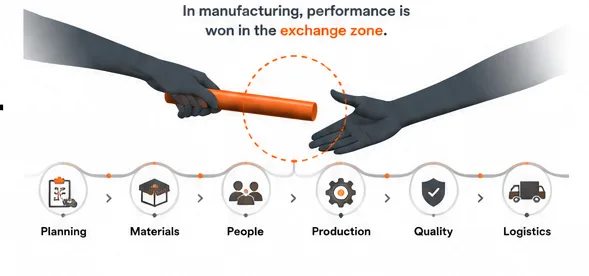
A relay race is a useful way to think about manufacturing.
The fastest four runners do not necessarily make the fastest relay team.
Individual speed matters, of course. But races are often won or lost in the exchange zone — in how well one runner hands the baton to the next without breaking momentum.
Factories work much the same way.
Planning, materials, people, machines, production, quality, suppliers and logistics each run a part of the race. What ultimately matters is not simply how well each performs independently, but how well the entire system moves together.
For us, three ideas capture this particularly well:
Speed. Flow. Efficiency.
Speed is increasingly about decisions
Manufacturing has traditionally associated speed with machines, cycle times and production rates.
But some of the most expensive delays in a factory happen while the machines are perfectly capable of running.
An operator is absent. A new style is about to start. Material is delayed. A line is not performing as expected.
Someone has to understand what has changed, consider the alternatives and decide what to do.
The quality of that response matters. So does the time it takes.
As factories deal with shorter lead times, smaller orders and greater variability, decision speed is becoming as important as production speed.
The gap between a signal appearing and an action being taken can itself become a significant source of lost capacity.
Where capacity gets lost
The factory can be ready while the decision is still waiting.
Something changes in the operating environment.
What happened, why it matters and what context is relevant.
Evaluate feasible alternatives and choose the best course.
Turn the decision into action while it still matters.
Flow is about the handoffs
A good relay team barely appears to slow down when the baton changes hands.
That is Flow.
In manufacturing, the baton may be material, information, work or simply a decision.
A plan moves from Industrial Engineering (IE) to production. Material moves from stores to a line. One shift hands over to another. Supplier information changes a production schedule. A quality issue needs to reach the right person quickly enough to change what happens next.
Factories can have excellent individual functions and still lose significant time between them.
People remain busy. Calls are made. Messages are exchanged. Spreadsheets are updated. Problems get solved.
Yet the factory slows down.
This is why manufacturing performance cannot be understood only by looking at individual processes.
The connections between them matter just as much.
Efficiency is about removing unnecessary effort
Efficiency is sometimes understood as making people or machines work harder.
The more interesting opportunity is often to remove work that should not have been necessary at all.
Waiting for information. Reworking a plan. Searching for the right operator. Discovering a skill gap after production begins. Making the same decision again because the situation has changed.
The same principle applies to materials, energy, water and other resources: use what is available intelligently and waste less of it.
Often, the capacity a factory is looking for already exists inside the factory.
Many factories may not have a capacity problem as much as a visibility and coordination problem.
AI can improve the handoffs
The opportunity for AI in manufacturing is not simply another dashboard or another automated report.
It is the ability to help people make better operational decisions.
A person may reasonably compare a handful of alternatives. AI can evaluate hundreds or thousands — considering skills, availability, constraints, historical performance and the consequences elsewhere in the operation.
It can bring fragmented information together at the moment a decision needs to be made.
It can help identify problems earlier.
And it can recommend what should happen next, rather than simply show what has already happened.
The objective is not to remove human judgment from the factory. It is to give the people running it better context, more options and more time to act.
This is the problem we built Genorai to solve.
Not by making one part of the factory exceptionally intelligent while everything around it continues as before, but by helping the whole system make better decisions — faster, with more context, and with a clearer understanding of what happens next.
Because, like a relay race, manufacturing is ultimately not about having the fastest runner.
Fast. Smoothly. And with as little wasted effort as possible.
Where is your factory losing productive time?
Start with one recurring production problem or manual task.